
The Tea Garden as Wildlife Habitat
What 30 tea gardens, 262 birds, and one certification study actually show.
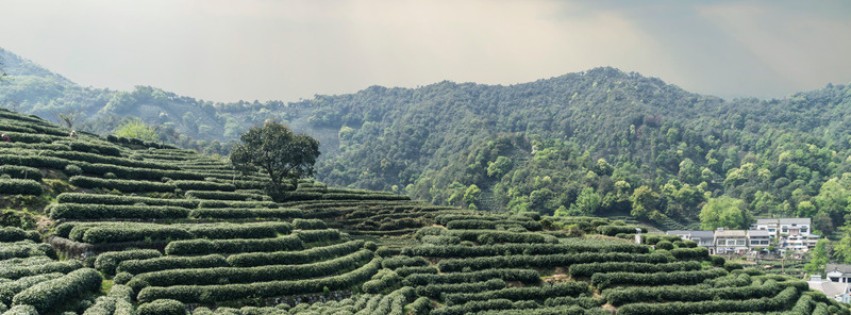
A bird lands in the leaves before the pickers do. At dusk, something smaller moves between the rows — a bat, working the last light for insects the day's heat brought out. Neither is passing through. Both are home. This is what a tea garden wildlife habitat actually looks like, once you know where to look.
We said as much in a shorter email a few days ago, and promised the fuller version. Here it is.
What the Anji County study actually found
In August 2021, five researchers from Zhejiang Sci-Tech University — Jueying Wu, Jinli Hu, Xinyu Zhao, Yangyang Sun and Guang Hu — spent a season counting birds across 30 tea plantations in Anji County, the part of Zhejiang Province known, with some pride, as the White Tea Capital. Their findings were published in February 2023 in the peer-reviewed journal PeerJ, under the title "Role of tea plantations in the maintenance of bird diversity in Anji County, China." They recorded 262 birds across 37 species and 23 families. Not a passing sample: a tree sparrow here, a light-vented bulbul there, barn swallows working the open rows in numbers — the three most commonly recorded species in the whole study.
The finding that matters most isn't the headline count. It's what the birds were doing there. The researchers split every species into two groups: birds that prefer built-up, human environments, and birds that prefer natural ones — forest, mountain, water. Both groups turned up in the tea gardens, in real numbers. That's the detail worth sitting with. A well-run tea garden isn't a compromise habitat that only the least fussy species will tolerate. It's genuinely doing two jobs at once — refuge for birds displaced by the forest edge shrinking, and overflow habitat for birds pushed out by the city expanding toward it. The researchers called it a transitional zone. We'd call it a garden doing more work than it gets credit for.
Why some gardens qualify and others don't
Not every tea garden earns this. The study found the birds that prefer natural habitats were drawn specifically to gardens planted with perennial herbs and shrubs — plants that come back year after year, with the height and density to actually shelter something. Birds happier around people showed up wherever the ground cover was simpler. Either way, the pattern held: structure attracts life. A tea garden stripped back to bare rows, sprayed hard, and replanted from scratch each season doesn't offer either group anything to work with. The birds aren't choosing tea. They're choosing what's been left standing around it — the trees kept for shade, the herbs left to establish, the ground not scoured bare.
That distinction is the whole argument for why we care about certification at all, and it's the part worth being precise about.
What certification is actually measuring
Rainforest Alliance certification requires estates to hold onto shade-tree diversity, protect the ground around streams and rivers, and cut back on agrochemicals — not aspirations, conditions written into the standard. Wildlife writer Muhammad Sadiq reported the figures in an April 2026 piece for Animals Around The Globe, titled "How Tea Plantations Support Biodiversity and Wildlife": research conducted on certified tea farms in Kenya compared those estates against nearby uncertified land and found 30% more bird species and close to double the mammal diversity on the certified ground. That's not a marketing number. It's the measurable difference between a garden managed to a standard and one that isn't.
Where Dragon Magic sits in this
Dragon Magic is grown in Yunnan Province — single-origin, nothing blended in. Yunnan is also where some of the oldest continuous tea-growing knowledge in the world still shapes how the land is worked: centuries of local practice integrating tea cultivation with the plant diversity and habitat around it, long before anyone called it agroecology. It's not the same garden the Anji researchers walked through — that study was Zhejiang Province, a different region entirely, and we won't pretend otherwise. But it's the same underlying idea, proven twice over in two different parts of China: leave enough of the wild in place, and the wild stays.
We'll keep the full studies on file for anyone who wants to read past our summary of them — reply to the email and we'll send them straight over.

Single-origin. Yunnan. Nothing blended in.
Grown in the same tradition this article describes — tea cultivated alongside the land, not instead of it.
JoJo
References
- Wu, J., Hu, J., Zhao, X., Sun, Y. & Hu, G. (2023). Role of tea plantations in the maintenance of bird diversity in Anji County, China. PeerJ, 11:e14801. DOI: 10.7717/peerj.14801.
- Sadiq, M. (2026). How Tea Plantations Support Biodiversity and Wildlife. Animals Around The Globe, published 29 April 2026.